

New Royal College Guidance on Aesthetics Training for Pharmacists

Updated guidance on aesthetics training for pharmacists has been released by the Royal College of Pharmacy (RCPharm). It highlights requirements for competent, safe aesthetic practice, patient care and complications management. We explore this announcement and explain why the Level 7 in medical aesthetics is the clear choice for clinical pharmacists.
The update, shared by the Royal College on 28 August 2026, sets out the official RCPharm position on pharmacists working as aesthetic practitioners.
Specific concerns centre around the need for:
- Appropriate aesthetics training that allows for demonstrable competence and safe practice in all treatments offered
- In-person, supervised practical aesthetics training
- Clinical consultation skills relating to both facial and psychological assessments
- The ability to recognise and manage complications related to aesthetic treatments
- Newly qualified aesthetic pharmacists to undertake supervised practice in order to meet competency criteria.
The stance echoes our own and the Harley Academy Level 7 Diploma in Cosmetic Injectables + Clinical Placement pathway. Read on to find out more about what the Royal College is requiring, and how Harley Academy can help pharmacists to meet these criteria.
Why Did the Royal College of Pharmacy Review its Position on Pharmacists in Aesthetics?
According to the RCPharm, this review was a response to “legislative changes” and the increasing numbers it’s been receiving about pharmacists practising aesthetic medicine.
The statement was intended to strengthen the “emphasis on the broader clinical responsibilities involved in delivering aesthetic treatments, recognising that pharmacists must be able to assess whether treatment is appropriate for an individual, consider psychological wellbeing, identify and manage risks, and respond effectively to complications.”
It follows a recent review from the General Dental Council relating to dentists practising aesthetic medicine.
What Aesthetics Training for Pharmacists Does the Royal College Recommend?
Whilst it stops short of recommending a specific aesthetics course for pharmacists, the statement provides guidance on what to look for from your training.
This is clearly set out as follows:
- “Appropriate training and supervised practice for all aesthetic procedures” the pharmacist provides, that ensure they can “demonstrate competence and safe practice”
- Mandatory “in person supervised” practical aesthetics training for pharmacists “alongside supplementary training courses, to develop and assess the procedural skills required for safe and competent aesthetic practice”
- Courses should prepare you to be demonstrably “competent in consultation and assessment skills, including psychological assessment”, with “safe and appropriate decision-making”
- Training must enable pharmacists to demonstrate “sufficient post-registration clinical experience and competence”, including “advanced consultation skills, clinical assessment, psychological screening, and the recognition and management of treatment-related complications”
- “Additional supervised clinical experience before practising independently in aesthetics” for all pharmacists who are newly-qualified in aesthetic medicine.
So, what does this mean in practice if you’re looking for the best aesthetics training pathway for pharmacists? Let’s break it down.
Why are these standards important?
The Royal College is clearly committed to upholding tenets of professionalism, competency and patient safety. It requires pharmacists to successfully complete robust aesthetics training courses that cover more than basic treatment administration.
The aim is to introduce standards whereby aesthetic practitioners are appropriately skilled in all aspects of clinical practice, from consultation, assessment and psychological screening to treating patients and are able to identify and manage any potential complications from those treatments offered.
Sound clinical judgement and true confidence cannot come from a one-day aesthetics course alone. Foundation training is a great way to start, but it should be a springboard for deeper learning. This appears to be the hurdle which the RCPharm is trying to overcome here.
Is the Harley Academy Level 7 aesthetics training right for pharmacists?
Obviously we’re biased, but even from a neutral standpoint, our Ofqual-regulated and JCCP-approved Level 7 Diploma in Cosmetic Injectables meets these substantial standards.
Whether taken at our aesthetics training academies in London or Manchester, this structured course is built on evidence-based techniques from the Global Evidence Matrix (GEM©). It includes:
- Detailed theory learning covering all aspects of practice relating to soft tissue injectables, including botulinum toxin and dermal fillers
- Hands-on, practical, supervised sessions from your foundation training to your Level 7 mentoring
- Moderated assessments, including practical exams, to demonstrate your competency
- A regulated aesthetic medicine Level 7 qualification, awarded by VTCT Skills, upon successful completion.
What theory learning does the Level 7 in aesthetics include?
Evidence-based aesthetic medicine theory is a huge part of what the Harley Academy Level 7 in Cosmetic Injectables offers. Enrolment provides a wide range of eLearning; some to be completed before your clinical sessions, whilst other parts are self-paced.
This includes, but is certainly not limited to, learning:
- How to consult and assess patients looking for cosmetic injectables
- Psychological drivers for patients considering aesthetic treatments
- Principles of skin ageing, facial ageing and anatomy
- Appropriate treatment planning, including product and tool selection, multi-area and multi-modal approaches
- Evidence-based injection techniques for soft tissue injectables, including botulinum toxin, and dermal fillers, in line with GEM© injection technique principles
- Complications management for soft tissue injectables
- Ethics and law in aesthetic medicine.
In addition to this, when you enroll, our Level 7 trainees receive a free 12-month subscription to Harley Pro at HarleyAcademy.ai. This is our online aesthetics learning system, which supports your development with an incredible array of additional content. It’s the perfect accompaniment to your course and includes:
- A wealth of flashcard-style learning on numerous topics including complications, cosmetic dermatology, and energy-based devices
- The full GEM© injection technique suite of content
- A library of 4K HD live and fully-narrated video injectables case studies
- Access to the latest research, where you can read the full paper, create an AI summary or listen to it, podcast-style
- Audio features and voice simulation tools where you can practice your consultation skills and gain feedback for how to improve
- Online courses including Success in Aesthetics (business, marketing, and entrepreneurship), KOL Training and our GEM© course, Certificate in Advanced Injection Techniques
- Protocols and clinical documentation templates and resources such as our Botulinum Toxin Injection Pattern Guide
- A chatbot Assistant which can answer your aesthetics queries by drawing from the Harley Academy knowledge bank and published research.
Plus, every minute you’re learning on the app, your CPD points will be calculated and diarised, ready to download and self-report!
How much practical aesthetics training do you get with the Level 7?
After completing your initial eLearning you can book your in-person Foundation Training in Medical Aesthetics. This is the first step in your Level 7 and is where you’ll spend a full day in our Manchester or London campus, with our approachable and knowledgeable mentors.
This first in-person session involves learning how to inject botox and dermal fillers on realistic mannequins, under the guidance of our clinical trainers. Then, in the afternoon, you’ll treat your very first real patient! Our supportive mentors will be with you every step of the way, so you can put your theory and morning learning into practice.
Once you’ve completed this Foundation Training, additional eLearning and one Observation Day, you can move on to your Level 7 mentoring sessions. Perhaps unsurprisingly, these are every trainee’s favourite part of the course.
They can be booked to fit in with your schedule so you can make the pace work for you.
You’ll get to complete 20 cases of soft tissue injectables, 10 of which will be botulinum toxin, through face-to-face, in-person, practical aesthetics training. These sessions are conducted 2:1 for added peer-to-peer learning that also keeps the sessions sufficiently small enough for enhanced educational value. We provide the patients, and your mentor will support you through each aspect of every appointment, from consultation and assessment to treatment and aftercare advice.
Your 10th case of botox will be your recorded Direct Observation of Practical Skills (DOPS) exam, as will your 10th non-toxin injectable case, where you’ll be assessed on filler skills.
This provides a robust amount of practical supervised practice for pharmacists training in aesthetic medicine.
How can having a Level 7 in Cosmetic Injectables demonstrate competency in aesthetics?
Harley Academy’s Level 7 in medical aesthetics is a respected, regulated and JCCP-approved qualification. We also enjoy separate JCCP approval as a postgraduate aesthetic medicine training provider for healthcare professionals. So, straight away, you’re ticking some credibility boxes.
Additionally, receiving your diploma to mark your successful completion of this qualification, allows medical professionals to demonstrate competency in a number of ways.
- It shows that you have completed an externally validated course - Ofqual-regulated, VTCT Skills-awarded, JCCP-approved - that is substantial in length
- Our Level 7 currently comprises an estimated 175 guided learning hours, taking you far beyond the scope of a one-day course
- This structured course builds your experience gradually, over a 12 to 24 month period, allowing you the chance to develop greater comprehension, competency and to build your clinical reasoning skills
- Harley Academy’s Founder & CEO, Dr Tristan Mehta is the co-creator of the Level 7 in aesthetic medicine. Developed around national clinical benchmarks, this qualification enables pharmacists to meet the current Health Education England (HEE) qualification requirements for the delivery of cosmetic procedures.
We know finding the right course is an involved process, so our team is always happy to chat through suitability with you. If you’d prefer to have a call with them, and get all your questions answered, simply book a call with them at your convenience.
How Can Newly Qualified Aesthetic Practitioner Pharmacists Gain Clinical Experience?
For pharmacists with a prescribing qualification, the Level 7 pathway outlined above unlocks the opportunity to apply to our Clinical Placement programme. This is exclusively open to late-stage Harley Academy Level 7 trainees and recent graduates who are prescribers.
Applicants are selected based on merit for seats on this four-month placement where you treat patients provided by us at The Academy Clinic London or Manchester, with our faculty on hand to support.
This scheme provides a wealth of additional cases for your portfolio, builds on your Level 7 knowledge with additional training - including advanced botulinum toxin treatments - and boosts your confidence in all areas of clinical practice.
Completing this placement will allow newly-qualified prescribing aesthetic practitioners to demonstrate practical clinical experience beyond their Level 7 course.
How Can Pharmacists Already Practising Aesthetics Meet These Standards?
If you’re a pharmacist who’s started working in aesthetics after a short course, this may not qualify as being able to demonstrate the requisite competency. This is something to enquire with the RCPharm about, however, if you want to be able to clearly demonstrate your aesthetics expertise without doing a full Level 7 course, we do have another pathway open to you.
Through Recognition of Prior Learning (RPL), the Harley Academy Fast Track Level 7 will fill this gap. It’s essentially our full Level 7 without the practical mentoring elements, as long as you meet our entry criteria and can provide the necessary evidence.
This is open to clinical pharmacists with sufficient experience in cosmetic injectables, who have already completed basic filler and botox courses, for example, but where their training doesn’t go far enough to meet the Royal College’s standards.
Our Fast Track route is a fantastic option for experienced medical aesthetics practitioners who have the experience, and now want the credentials to formally recognise it.
Complications Management Requirements for Aesthetic Pharmacists
A hot topic right now, the ability to recognise and appropriately manage complications from aesthetic procedures was a focus for the RCPharm.
“Complications can occur in aesthetics as they can with any clinical procedure, but complications management is not always covered in training for aesthetic practitioners,” it notes. “The Australian Health Practitioner Regulatory Authority’s (Ahpra) Guidelines for registered health practitioners who perform non-surgical cosmetic procedures clearly states that practitioners must be able to recognise and manage complications or emergencies arising from aesthetic practice. RCPharm similarly provides an explicit recommendation in this area…”
This is in alignment with the guidance in the RCPharm prescribing competency framework which requires pharmacists to “understand the potential for adverse effects and take steps to recognise and manage them while minimising risk”.
The disparity between England, Ireland, Scotland and Wales in relation to stock-holding was noted. However, the statement called for pharmacists in aesthetic practice to “understand and adhere to the current medicines legislation for the nation in which they are working”. Adding, “The Royal College of Pharmacy will work with relevant stakeholders to explore mechanisms that enable equitable access to emergency medicines, including adrenaline, to support the safe management of complications and improve safety in aesthetic practice.”
How can aesthetic practitioners get experience in complications management?
Complications training is almost always theory-based, given its nature, so confidence comes with time.
Our Level 7 eLearning and Harley Pro content on HarleyAcademy.ai covers a range of botox and filler complications topics. These include providing aesthetic education and protocols for dealing with many potential adverse events, from simple swelling and oedema, to ptosis and vision loss.
Obviously we recognise that theory-only learning, coupled with especially the more severe aesthetic complications being quite rare, doesn’t make clinicians entirely confident. But complications do happen to practitioners of all experience levels, and you need to know how to handle them.
In addition to theory learning, we recommend running regular complications drills, and keeping up-to-date with your protocols and insurance requirements for complications management. But, in reality, when a complication strikes - especially if you’re a sole practitioner and/or new to the specialty - you often need backup.
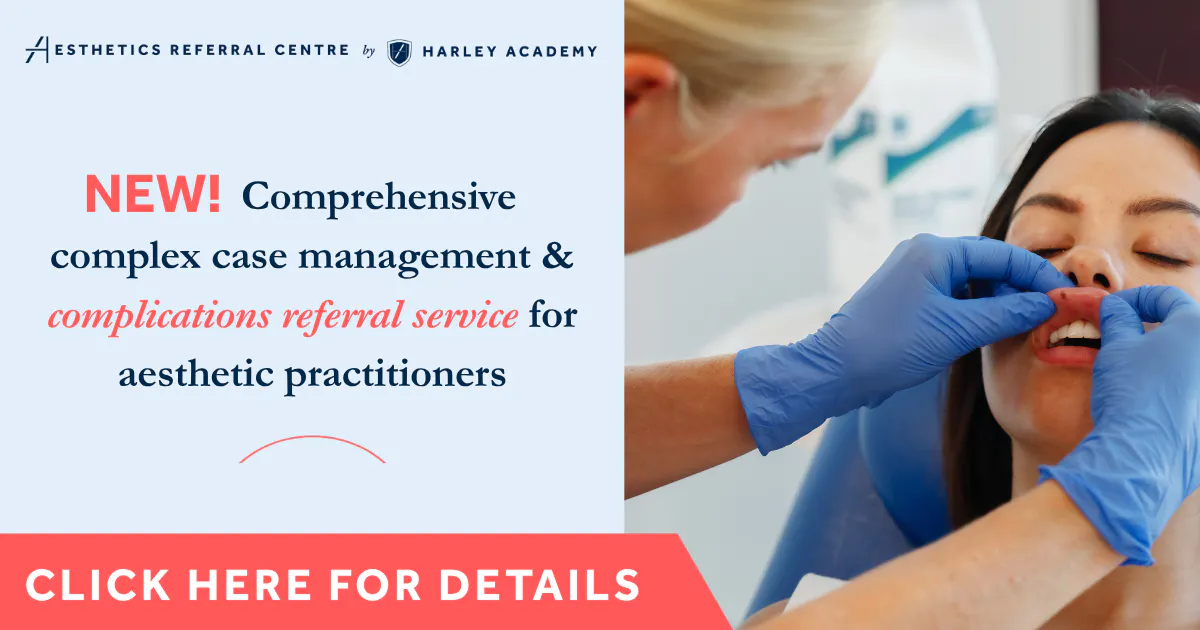
Whether it’s a second opinion, or someone you want to refer your patient to for assessment and treatment, having that safety net in place is important for your peace of mind and your patients’. This is why we’re launching the Aesthetics Referral Centre, a London-based complications clinic, where a subscription means our full clinical team stays ready to support both you and your patient when you need them.
This service is only available to medical aesthetics professionals, and includes a number of comforting and genuinely helpful resources for clinicians. Having an active subscription allows you to demonstrate that you take complications management seriously, and are prepared for any scenario.
We’ll be announcing its launch soon, but in the meantime, if you’d like to know more, you can arrange a call with our Aesthetics Referral Centre subscription team.
Other RCPharm Guidance for Pharmacists in Aesthetic Medicine
The Royal College’s full statement was not restricted to just the education and training side of aesthetic practice. Additional guidance was provided, to help pharmacists practising in aesthetics meet and uphold the standards the body, and patients, expect.
Join a volunteer practitioner register
Recommendations were made to join a voluntary aesthetic practitioner register, such as the Joint Council for Cosmetic Practitioners (JCCP) or SaveFace registers, was highlighted. “These organisations offer pathways to assurance of competence to practice”, the statement reads.
Harley Academy was the first postgraduate aesthetics training provider for healthcare professionals to become JCCP-approved. We continue to encourage our trainees and graduates to join its register so patients looking for reputable medical clinicians can find them, and get that reassurance. You can find out more about how to join the JCCP practitioner register on the organisation’s website.
Engage in continual professional development relating to aesthetics
The RCPharm stressed that pharmacists “must engage in continual professional development relevant to their aesthetics practice, with relevant training that is regularly updated and assessed. Their GPhC revalidation should reflect this ongoing learning to provide evidence of continued competence in aesthetic practice.”
Clinical settings, record-keeping and responsible product sourcing
Additional requirements were listed relating to ensuring clinical settings and products were appropriate and met all existing requirements for safe practice. This included use of regulated treatment products with appropriate UK approvals sourced from reputable suppliers.
We hope this information has been helpful and encourage you to read the Royal College of Pharmacy’s statement in full. In the meantime, if you’re a pharmacist looking to get started in aesthetics and want to make sure you choose the appropriate training course, we’d be happy to help.
All information correct at time of publication
Download our full prospectus
Browse all our injectables, dermal fillers and cosmetic dermatology courses in one document
By submitting this form, you agree to receive marketing about our products, events, promotions and exclusive content. Consent is not a condition of purchase, and no purchase is necessary. Message frequency varies. View our Privacy Policy and Terms & Conditions
Attend our FREE open evening
If you're not sure which course is right for you, let us help
Join us online or in-person at our free open evening to learn more
Our Partners












STAY INFORMED
Sign up to receive industry news, careers advice, special offers and information on Harley Academy courses and services