

Aesthetics Regulation Proposals Released for High-Risk Treatments
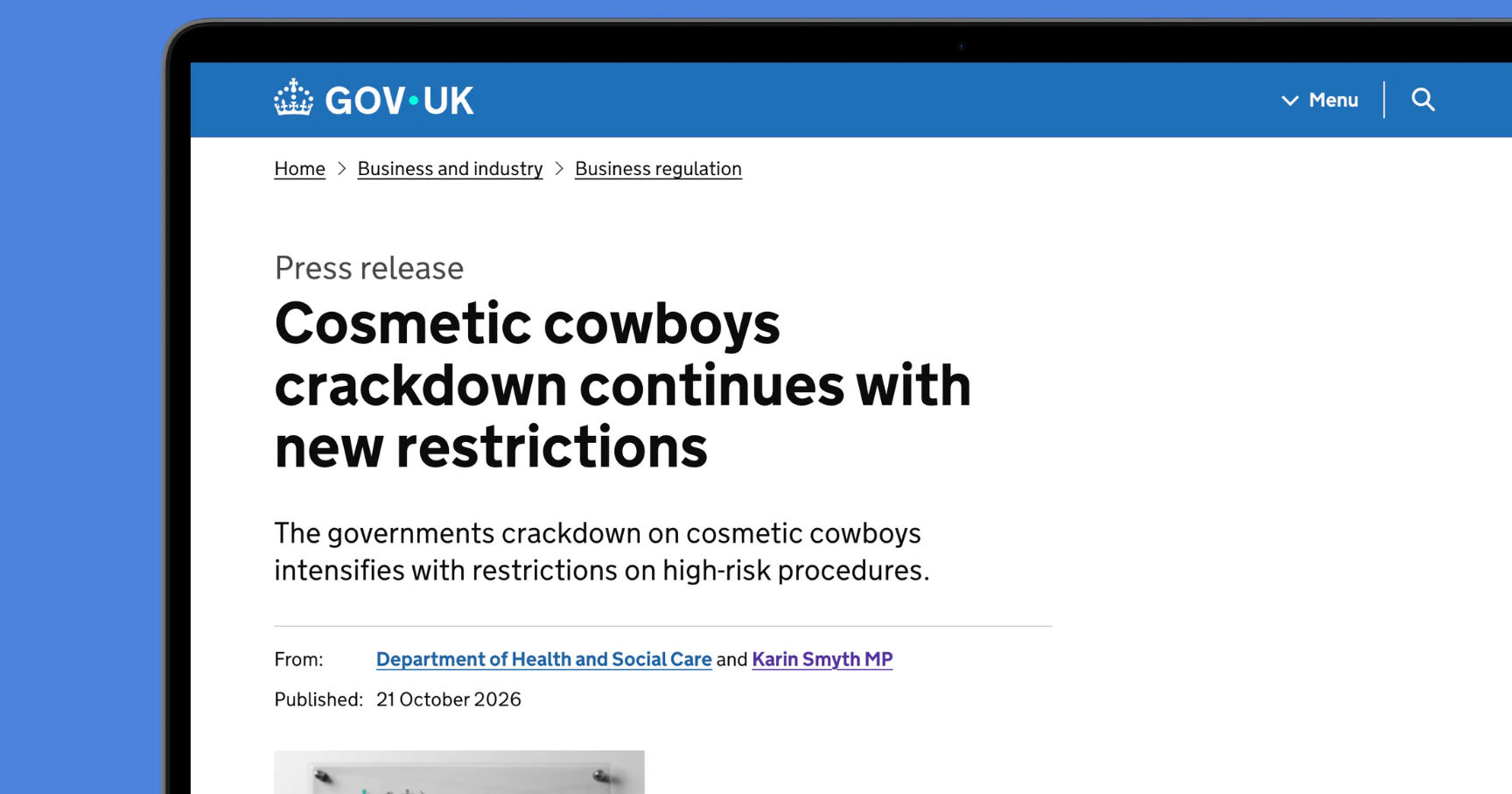
We are one step closer to finally implementing real aesthetics regulation in England, thanks to new legislative proposals. Today, 21st October 2026, the Government has set out how it intends to regulate “high-risk” non surgical cosmetic procedures and has put them to a public consultation.
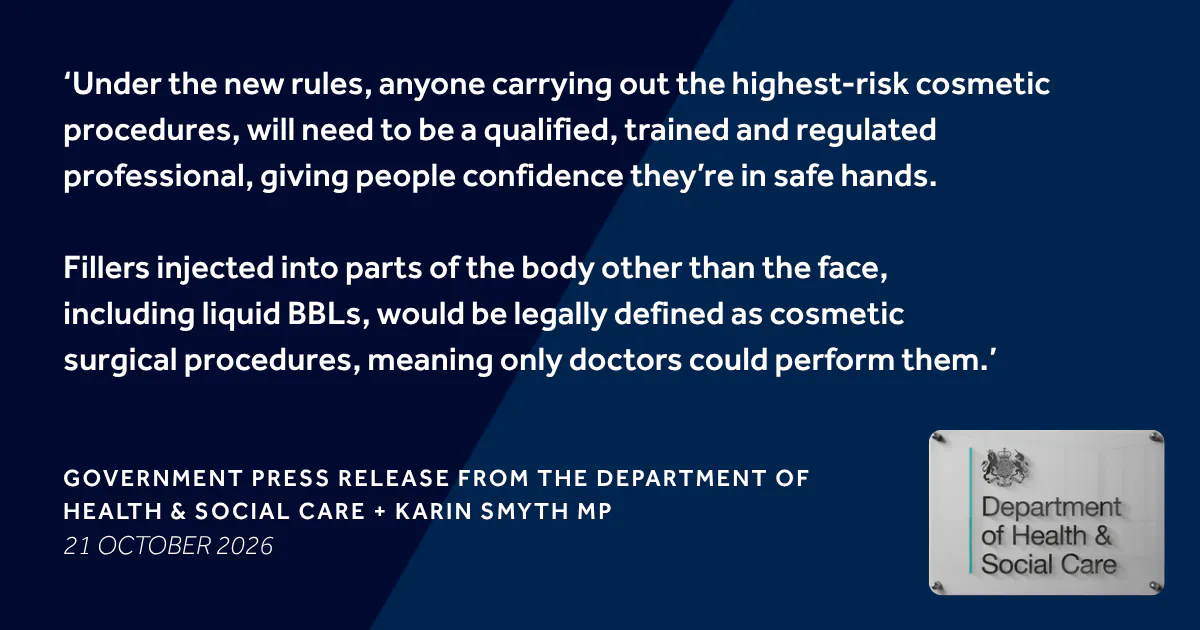
In a press release, the Department of Health & Social Care (DHSC) responsible for this area and Minister of State for Health (Secondary Care), Karin Smyth MP, state the aim of this intended legislation: ‘Under the new rules, anyone carrying out the highest-risk cosmetic procedures, will need to be a qualified, trained and regulated professional, giving people confidence they’re in safe hands.’
Smyth added, 'These changes mean that only properly trained professionals can carry out the most serious, high-risk procedures, and that young people will be shielded from treatments that can go badly wrong.'
Read on to find out what aesthetic practitioners need to know about these long-awaited and much-needed proposals plus how to respond to the consultation. We also set out what this news means for regulating the amber and green treatment categories, including botox and fillers.
Please note: This is a developing story so we will update it as more information becomes available.
Why is Regulation Needed?
This may seem obvious given the regular horror stories reported in the media, including fatalities, relating to unregulated practise of aesthetic procedures. However, it's worth considering why the government believes this is necessary. You may find their stance interesting given they note the need to essentially balance commercial opportunity with patient safety.
In the consultation, Karin Smyth notes, 'We do not wish to prevent people from being able to access safe cosmetic procedures if they wish to do so. However, anyone opting to have a cosmetic procedure should do so in the knowledge that it will be carried out by skilled practitioners in appropriate premises. In too many cases, these standards are not met.
'Public safety is paramount. We are clear on the principles of safe practice and the need for further regulation, but we want to make sure that government action is proportionate and enforceable. We must protect the public from harm while not unnecessarily restricting the activities of legitimate businesses.'
What Are the High-Risk Non-Surgical Cosmetic Procedures Being Regulated?
Before we get into the details of what’s being recommended, let’s look at which treatments these proposals actually relate to.
These can be broken down into surgical and non-surgical categories, as 'fillers injected into parts of the body other than the face, including liquid BBLs, would be legally defined as cosmetic surgical procedures'.
Surgical procedures named in the proposals include:
- Non-facial body fillers, such as liquid BBLs
- Surgical body contouring
- Liposuction
- Thread lifts.
Named non surgical treatments include:
- Deep chemical peels
- Specified high-risk laser and intense pulsed lights treatments
- Intravenous procedures such as IV drips
- Dermal microcoring
- Subcision
- Blood or plasma therapies, including PRP facials
- Non-resorbable fillers
- Those including the administration of an anaesthetic as a separate injection.
Who Will be Able to Carry Out High-Risk Cosmetic Procedures Under These Regulations?
High-risk surgical procedures restricted to GMC-registered doctors
The proposed legislation legally restricts high-risk surgical procedures to General Medical Council (GMC) registered doctors.
If you hold GMC registration, these would remain within your remit. Anyone who has been performing these procedures without the necessary GMC registration will no longer be able to do so.
High-risk non surgical treatments restricted to regulated healthcare professionals
The list of high-risk non-surgical aesthetic treatments would be restricted to regulated healthcare professionals (HCPs) only. This tier represents a broader range of professionals than the surgical category.
Who is considered a healthcare professional in this situation?
The consultation proposals state that, in this respect, HCPs means:
- Doctors
- Dentists
- Independent prescribing nurses
- Independent prescribing midwives
- Independent prescribing pharmacists.
These healthcare professionals must be subject to statutory regulation by a regulatory body, such as the General Medical Council, General Dental Council, Nursing and Midwifery Council or General Pharmaceutical Council.
All of these specified aesthetic practitioners offering red category treatments would also need to be registered with the Care Quality Commission (CQC).
High-Risk Procedures Require a Clinical Environment and CQC Registration
In a bid to end unsafe treatment settings, the DHSC plans to restrict high-risk cosmetic procedures - surgical and non-surgical - to clinics with CQC registration.
They would limit the offering of “red” - high-risk - procedures to selected healthcare professionals working in a clinical environment, and make Care Quality Commission (CQC) registration mandatory.
The draft legislation targets loopholes that have allowed procedures to be carried out in hotel rooms and unregulated home setups. For appropriate medical aesthetics practitioners already working from CQC-registered premises, there will likely be no change should this legislation pass.
Ban on Cosmetic Procedures for Under 18s
Bringing the highest-risk treatment category in line with the existing age restrictions for cosmetic injectables in England, a ban would be put in place for under 18s.
In 2021, England introduced a ban on booking appointments, consultations and carrying out cosmetic botulinum toxin and dermal filler treatments for under 18s. Doing so is a criminal offence.
This new proposal would align all cosmetic procedures across the categories, restricting them all to over 18s only. However, it’s worth noting that this only applies to England at the moment. Other parts of the UK are expected to follow suit so a “joined up” approach can be taken to prevent cosmetic tourism.
Strict criminal penalties would apply to those breaking this law, including ‘unlimited court fines or imprisonment’.
All aesthetic practitioners should take this as a reminder to review their age verification protocols, to ensure they’re suitably robust.
What Are the Penalties for Breaching these Regulations once Implemented?
Should this legislation pass into law, the penalties for breaking it have also been considered. The consultation states: 'Breaching these regulations would be a criminal offence. Providers who carry out these procedures without CQC registration could face a fine of any amount, a prison sentence of up to 12 months, or both. Providers who allow a procedure to be performed by an unqualified practitioner could also face a fine of any amount.'
What are the Key Dates for Introducing Aesthetics Regulation to England?
There are three dates worth noting:
- Wednesday 21st October 2026: Draft regulations released by the DHSC and online public consultation opens
- 11:59pm on 13th January 2027: 12-week online public consultation closes
- Spring 2027: Legislation is set to go before Parliament.
The consultation isn’t online yet but we’ll update you with the relevant link and any further information as soon as this is live. You can, however, read the press release in full on the DHSC website now.
How Do I Respond to the Consultation?
The consultation has now been published on the DHSC website. You can visit the webpage to read through the proposals and submit your responses.
You must submit your answers by 11:59pm on 13th January 2027 for them to be counted.
After reading through the full proposals, you'll be asked:
- Whether you agree or disagree with these proposals
- Which procedures and professional groups should be included
- What effect the changes would have on you, your business or the people you work with.
What’s the Plan for Regulating Lower-Risk Aesthetic Treatments Such as Fillers and Botox?
As part of today’s announcement, the government reiterated its commitment to a nationwide aesthetics licensing scheme. It would cover “lower-risk” amber and green-rated treatments, such as Botox and fillers.
This remains an area requiring urgent attention, and - like many in the industry - we hope this current regulatory momentum is maintained so those measures follow swiftly.
In the announcement, the government states it wants to put ‘an end to backyard Botox clinics’ via a new licensing scheme.
With the high-risk treatment consultation scheduled to end in January 2027, it’s unlikely we’ll see any movement on these categories before then. However, the acknowledgement that the government has not forgotten about these widespread treatments in the lower-risk categories is welcome.
You can get a reminder as to what was originally proposed in relation to regulating these treatments, and the licensing scheme for both aesthetic practitioners and their premises, in our article on the last proposals.
What Does This Mean for How You Run Your Aesthetics Clinic Now?
As an existing aesthetic practitioner, it's worth considering these proposals through a practise-building lens. Sound clinical judgement and sound business judgement tend to point the same way.
- Audit your treatment menu. Note which treatments sit within the high-risk category
- Check your regulatory standing. If you have a team, confirm who regulates each aesthetic practitioner
- Review your premises. Consider what CQC registration involves for your setting
- Update your patient information. Make age requirements clear from first contact
- Plan your aesthetics training needs. Identify any competency gaps before rules take effect. Use this time before laws are passed to ensure you have demonstrable expertise in every treatment you offer
- Prepare a consultation response. The deadline is 11:59pm on 13th January 2027.
If you would like to explore getting your aesthetics training up-to-date with structured online and practical learning, a JCCP-approved and Ofqual-regulated qualification, speak to our team. As the first postgraduate aesthetic medicine training provider to receive JCCP approval, and with over 10 years at the forefront of evidence-based aesthetic education, we’re well placed to support you.
All information correct at time of publication
Download our full prospectus
Browse all our injectables, dermal fillers and cosmetic dermatology courses in one document
By submitting this form, you agree to receive marketing about our products, events, promotions and exclusive content. Consent is not a condition of purchase, and no purchase is necessary. Message frequency varies. View our Privacy Policy and Terms & Conditions
Attend our FREE open evening
If you're not sure which course is right for you, let us help
Join us online or in-person at our free open evening to learn more
Our Partners












STAY INFORMED
Sign up to receive industry news, careers advice, special offers and information on Harley Academy courses and services