

Aesthetics Regulation: UK Training & Qualification Requirements
Scotland has progressed aesthetics regulation plans ahead of its Stage 1, February 2026 deadline. These include updates on aligning all UK nations with standardised requirements for practitioners’ aesthetics training and qualifications.
Here we explore the new recommendations made by the Scottish Health, Social Care and Sport Committee. These include:
- Who can practice non-surgical aesthetics and supervision
- UK alignment on minimum, mandatory aesthetics training and qualification requirements for aesthetic practitioners
- Enforcement of the new legislation and penalties for non-compliance.
It has also been advised that these procedures will be restricted to over 18s.
This report was published online on 27 January 2026, ahead of the 5 February 2026 deadline for completion of Stage 1. A Parliamentary debate will then take to ‘consider and decide on the general principles of the Bill’ in its final Stage 1 form.
Here we explore some of the latest updates to the proposed Bill. We also explain what UKIMA is and why it may be a regulatory stumbling block.
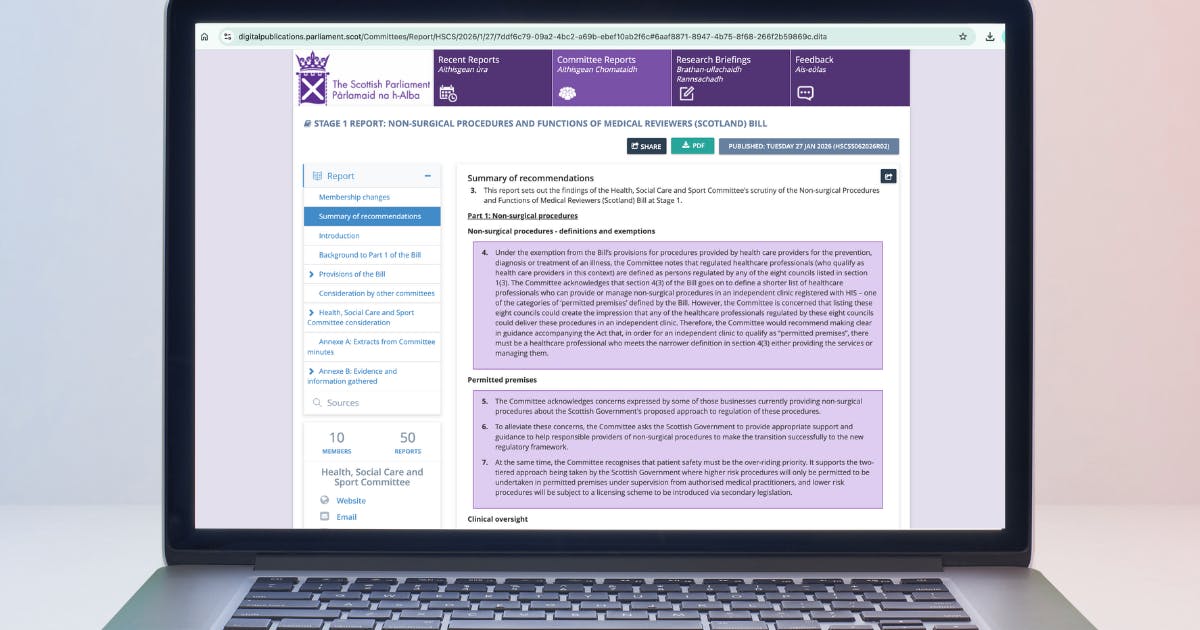
Scottish aesthetics regulation Stage 1 Bill updates
Let’s break down each of these new recommendations following scrutiny of the original Bill proposals and evidence from public and stakeholder consultations.
NB. If you’d like to refresh your knowledge of where we are with aesthetics regulation in Scotland and England, take a look at our previous article. This is a follow-on which takes a deeper dive into the proposed changes to the Non-Surgical Procedures and Functions of Medical Reviews (Scotland) Bill at Stage 1.
1. Who is considered a ‘healthcare professional’?
Part 1 of the new report relates to non-surgical procedures; the following points were raised under the heading ‘Definitions and Exemptions’.
The the Health, Social Care and Sport Committee noted the definition of ‘regulated healthcare professionals’ in the context of the current Bill proposals. It highlighted an error that outlined those persons able to provide or manage non-surgical procedures in Healthcare Improvement Scotland (HIS) registered clinics as a:
- Registered medical practitioner,
- Person registered in the dentists register under the Dentists Act 1984,
- Registered nurse who is noted in the Nursing and Midwifery Register as being qualified to order drugs, medicines and appliances as a nurse independent prescriber,
- Registered midwife who is noted in the Nursing and Midwifery Register as being qualified to order drugs, medicines and appliances as a nurse independent prescriber,
- Pharmacist independent prescriber.
A new recommendation was made on this point. Clear guidance is required to accompany the Act, explaining that this list, above, is correct. And,‘in order for an independent clinic to qualify as “permitted premises”, there must be a healthcare professional’ who meets this criteria ‘either providing the services or managing them.’
2. Two-tier approach to who can administer higher risk aesthetic treatments
We’ve previously covered the topic of Scotland backing non-medics being able to administer injectables under supervision.
The Committee reiterated its support for a two-tiered approach to who can perform non-surgical cosmetic procedures in Scotland. This relates to ‘higher risk procedures’ being restricted.
These restrictions mean:
- Higher risk aesthetic treatments: Must be carried out in ‘permitted premises’ where the practitioner receives supervision ‘from authorised medical practitioners’
- Lower risk cosmetic treatments: Will be ‘subject to a licensing scheme to be introduced via secondary legislation’.
Non-medics must have appropriate clinical supervision
The controversial proposal of ‘supervision’ for non-medics was addressed in these new recommendations.
Report entries on this, state, ‘The Committee highlights significant evidence from its Stage 1 scrutiny that the Bill lacks detail on the question of clinical supervision including minimum requirements for supervision, clinical as well as managerial aspects of supervision, and minimum qualification requirements for those providing supervision.’
It felt that ‘a lot of this detail will need to be addressed in secondary legislation’. Related concerns relating to UKIMA were also expressed, which we’ll explain later in this article.
Evidence was heard advising that ‘having the status of a regulated health care professional does not, of itself, demonstrate any prior experience of the non-surgical procedures covered by the Bill that would be necessary to fulfil the supervisory responsibilities envisaged by the Bill to a suitably high standard’.
The Committee asked the Scottish Government to set out its proposals for its approach with regards to both the Bill and this secondary legislation. It reiterated a request for input on ‘minimum training and qualification standards’ that ‘supervising clinicians will additionally be required to demonstrate.’
3. Standardised UK aesthetics training quality and mandatory qualifications
Evidence relating to the ‘huge variability’ in quality of aesthetics training and qualifications was considered by the Committee. It felt ‘clear and appropriate standards’ will be ‘critical’ to the Bill’s success.
This resulted in recommendations for secondary legislation for the UK - not just Scotland - which defines requirements for aesthetics training, qualifications and standards. The Scottish Government was asked for assurance on this, and that it would include:
- Standardised aesthetic education and training standards across the UK
- Aesthetic practitioners being required to have a ‘suitable level of training’ and qualification in:
- Health protection and infection control
- Patient mental health screening
- Obtaining informed consent
- Managing complications safely and effectively
- Ensuring those whose training does not meet new mandatory standards are ‘unable to act as providers’.
We understand work is going on in the background exploring what these actual training and qualification requiremens will be. However, it has long been stressed that, especially for higher risk procedures such as botulinum toxin and dermal fillers, these will need to be robust, with regulated qualifications.
Regulated aesthetics qualification for practising injectors
If you’re a healthcare professional in Scotland - or the rest of the UK - who’s also an aesthetic practitioner, and you’re looking to formalise your experience with a regulated qualification, we can help.
Elevate your certified aesthetic education with a JCCP-approved Fast Track Level 7 Diploma in cosmetic injectables. This expedited, accredited medical aesthetics course allows you to concentrate on remote deep theory learning.
Through this pathway for clinicians who meet our entry requirements, you can learn from your own home or clinic, in your own time. You’ll fit studying for this prestigious and robust qualification around your schedule, and can achieve an internationally-recognised Diploma within 12 months. This also provides you with a certificate and the post-nominal title, PGDipAes.
Our flagship Level 7 Diploma in Cosmetic Injectables qualification, which takes around 12-24 months to complete, is suitable for beginners. This comprises 175 hours of self-paced theory eLearning, hands-on mentored practical training, observed case sessions, a number of assessments and more. If you’re a medical professional looking for a recognised, respected and regulated pathway into aesthetics, this is for you.
4. Enforcing regulations and penalisation for non-compliance
The issue of how to enforce any regulatory changes has always been a source of widespread concern. So too has the issue of how to penalise non-compliance, particularly given worries regarding Healthcare Improvement Scotland (HIS) not having the appropriate capacity and resources.
After considering evidence on this, the Committee confirmed that the proposed ‘level of sanctions… will be an insufficient deterrent’. It, therefore, requested the Scottish Government to ‘set stronger penalties’.
An acknowledgement was made to the plan for HIS to become self-financing from registration fee income. However, additional funding assurances were sought for the short term.
The Committee also asked the Government for a published ‘implementation route map’ for HIS that covers:
- Systems and resources for inspection and enforcement
- Timescales for suitable training, systems and evidence-handing processes
- How HIS will work with ther agencies, including Police Scotland and local authorities to enforce the Bill and its related licensing scheme.
Staggered introduction
The time it may take ‘responisble operators’ to comply with new laws was taken into account. Additional information was requested in this regard, with the Committee asking the Scottish Government to set out its plans for the roll out. This should include a staged approach, to allow for proper compliance, and details of any financial support during this process.
The Committee was strongly in favour of an approach which allowed ‘responsible’ providers ‘the time and support they need to achieve full compliance while appropriately punishing those irresponsible operators that commit repeat offences and show no signs of taking the necessary steps to comply with the law’.
5. Support for aesthetic practitioners and businesses during transition
The Committee acknowledged concerns about the potential impact of regulations expressed by current aesthetics providers. Little detail was given as to what these were or who made them.
Although it’s easy to assume this may relate to non-medics, healthcare professionals also had a number of reservations in this respect when the draft Bill was released.
Many related to cost, restricted service offerings and HIS-registration becoming mandatory for all aesthetic practitioners, including non-medics, and the system overwhelm this may cause.
In this new report, the Committee calls on the Scottish Government to ‘provide appropriate support and guidance’. This should ‘help responsible providers of non-surgical procedures to make the transition successfully to the new regulatory framework’.
It did stress, however, that ‘patient safety must be the over-riding priority’.
The Committee further requested the Government engage ‘meaningfully with independent aesthetic practitioners to understand how they will be impacted by the Bill, what forms of support would be most helpful and to ensure they are kept informed during the implementation process.’
6. Additional points raised
Other updated recommendations related to:
- Gathering ‘much more systematic data’ on non-surgical procedure success and complication rates. This will be used, in part, to monitor and evaluate the Bill’s success. Requests revolved around who would be responsible for gathering data for HIS, and associated resource requirements
- Tackling misleading advertising of aesthetic procedures through additional steps to be agreed in collaboration with the UK Government. It was noted that the UK Government is leading on policy for advertising regulation, and it largely falls outside of the scope of the Scottish Bill
- Classification and regulation of certain substances used in non-surgical procedures, in coordination with the UK Government and MHRA
- The need for a public information awareness campaign to explain changes in the law and allow patients to make properly informed decisions. This was also deemed vital to minimising ‘cosmetic tourism’. Alignment across the UK was stressed here to prevent this type of ‘tourism’ between UK nations. The Financial Memorandum associated with the Bill should account for this.
What is UKIMA and why is it relevant to aesthetics regulation?
The UK Internal Market Act 2020 (UKIMA) focuses on the smooth, post-Brexit functioning of trade across all UK nations.
It’s intended to balance the need for stricter rules with the need for a free internal market. However, devolved regulations, where rules differ between UK nations, may be deemed “unenforceable” or open to legal challenge.
The “Market Access” Principle is causing particular regulatory hurdles for Scotland who are ahead of England, here.
This principle essentially means that an aesthetic practitioner who’s legally qualified to work in one part of the UK should generally be allowed to work in other parts. This limits the ability of devolved governments to impose localised rules for their nation, such as:
- Restricting certain aesthetic procedures to specific healthcare professionals
- Minimum standards for the quality of aesthetic education and qualifications
- Mandatory aesthetics qualification requirements for practitioners
- Compulsory aesthetics licensing scheme for practitioners.
To be compliant with UK-wide market regulations, it’s likely Scotland will need to align with England, and the other UK nations. This approach has historically been what was assumed would happen, with England taking the lead. But Scotland has forged ahead as England stumbled, and now the two governments are in conversation as to how UK rules could work.
The Scottish Committee has asked its government for an update on how these UKIMA discussions are going.
With the Stage 1 Bill set to be finalised this week, Scotland’s timely progress is welcome. However, it seems as if there’s still quite a way to go, especially when it comes to UK alignment on key aspects.
Information correct at time of publication
Download our full prospectus
Browse all our injectables, dermal fillers and cosmetic dermatology courses in one document
By submitting this form, you agree to receive marketing about our products, events, promotions and exclusive content. Consent is not a condition of purchase, and no purchase is necessary. Message frequency varies. View our Privacy Policy and Terms & Conditions
Attend our FREE open evening
If you're not sure which course is right for you, let us help
Join us online or in-person at our free open evening to learn more
Our Partners





STAY INFORMED
Sign up to receive industry news, careers advice, special offers and information on Harley Academy courses and services